Seven and a half years on the commercial side of CPG

Each step came with more ownership: from writing requirements, to owning a 22-country field platform, to leading an award-winning AI pricing product, to building my own AI agents.

Business Analyst · Tata Consultancy Services

Learning how CPG sells

I started as a Business Analyst and CPG domain consultant. I turned commercial problems into process maps, requirements and acceptance criteria, and I led the requirements for the first build of a global sales-execution platform: customer planning, outlet visits, order capture, promotions, contract compliance, and the CRM, ERP and logistics integrations behind them.

I also set up one shared requirements framework for delivery teams from several vendors, and assessed revenue growth management, digital commerce and loyalty options for European CPG companies.

1Requirements frameworkShared by business analysts, engineers and QA across multiple delivery vendors.
2020Promoted to Product OwnerOn the same Fortune 500 engagement, to own the platform I had specified.
Product Owner · AI & Global Digital Platforms · 22 markets

One app for 22 countries, and the shelf it measured

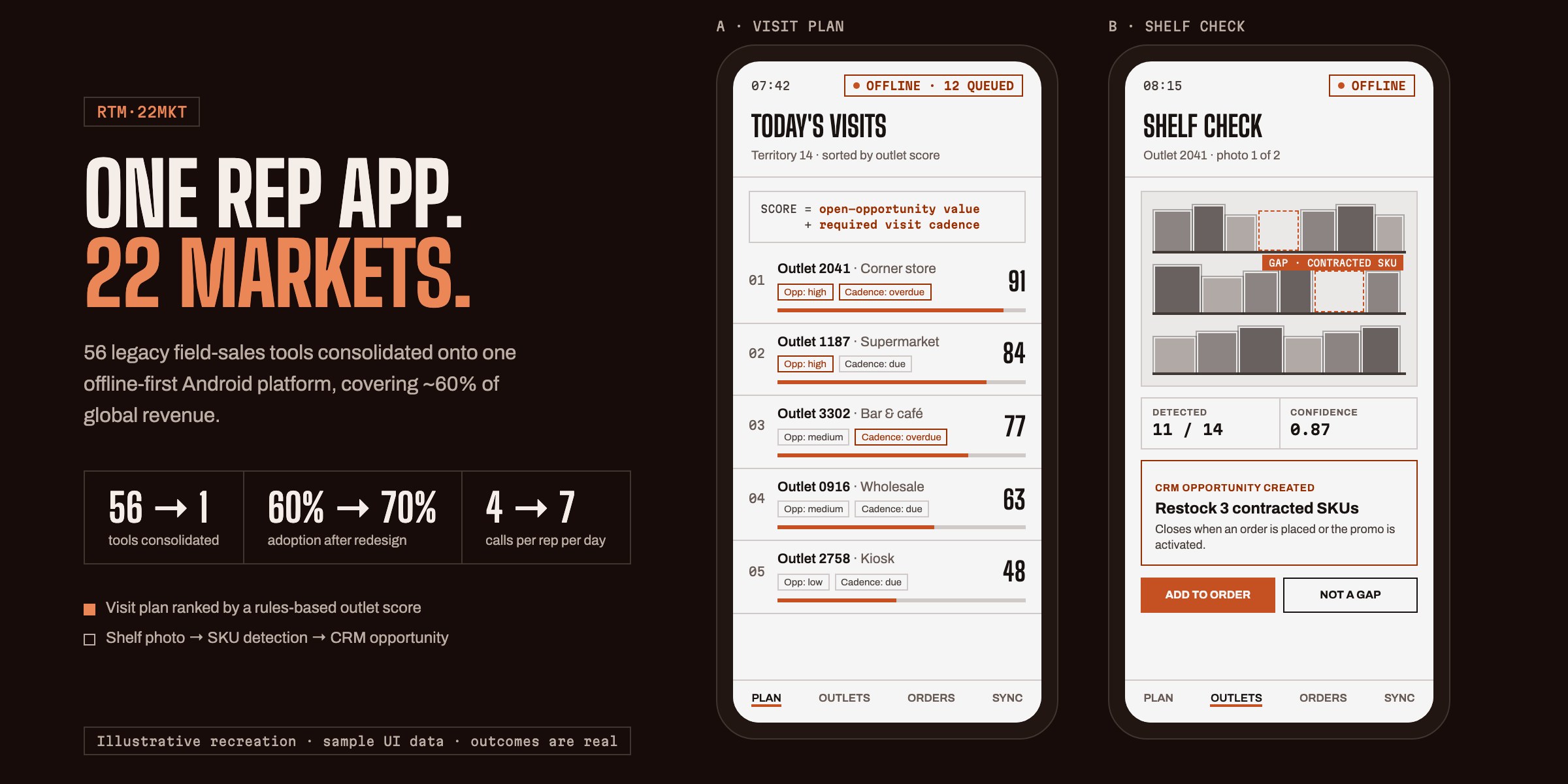
I owned the mobile platform that replaced 56 legacy field-sales tools with one offline-first app, covering about 60% of the client's global revenue, with a 30+ person team across engineering, QA, architecture and change management.

Adoption stalled at 60%. The dashboards showed what reps used but couldn't explain why they avoided the rest, so I shadowed reps in the most resistant market. The global build had dropped functions some countries still needed. We kept one global process and built local needs in as country settings, and adoption rose to 70%.

Contracts also committed each outlet to a product mix and live promotions, but nobody at headquarters could see a shelf. I productized a third-party computer-vision model into a closed loop, and measured it on whether the gap closed after the rep acted.

  1. Rep photographs the shelf
  2. AI detects SKUsvs. contracted mix
  3. Gap becomes a CRM opportunity
  4. Rep acts in the visit
  5. Verified: order placed or promo live
~30%More outlets on target SKU mixAfter shelf photos were turned into sales actions.
~20%More outlets on promotion mixMeasured on closed gaps, with a rep override for false flags.
56→1Legacy tools replacedOne codebase, with 120+ workflow differences sorted into global, regional and market settings.
60→70%Field adoptionFixed with field research in the most resistant market.
4→7Calls per rep per dayA simple rules-based visit score beat the CRM vendor's ML route planner. 12% productivity gain.

Also shipped in this chapter: a Salesforce Commerce Cloud self-service portal for 300,000+ business buyers, live in under 9 months, with a 15% CSAT improvement and about 18% more repeat orders.

Case study: Sales Execution 56→1The consolidation, the adoption fix, where computer vision fit, and the ML pilot I shut down.Read it →
Product Manager & GTM Lead · AI SaaS

Pricing and promotion decisions, with a human in charge

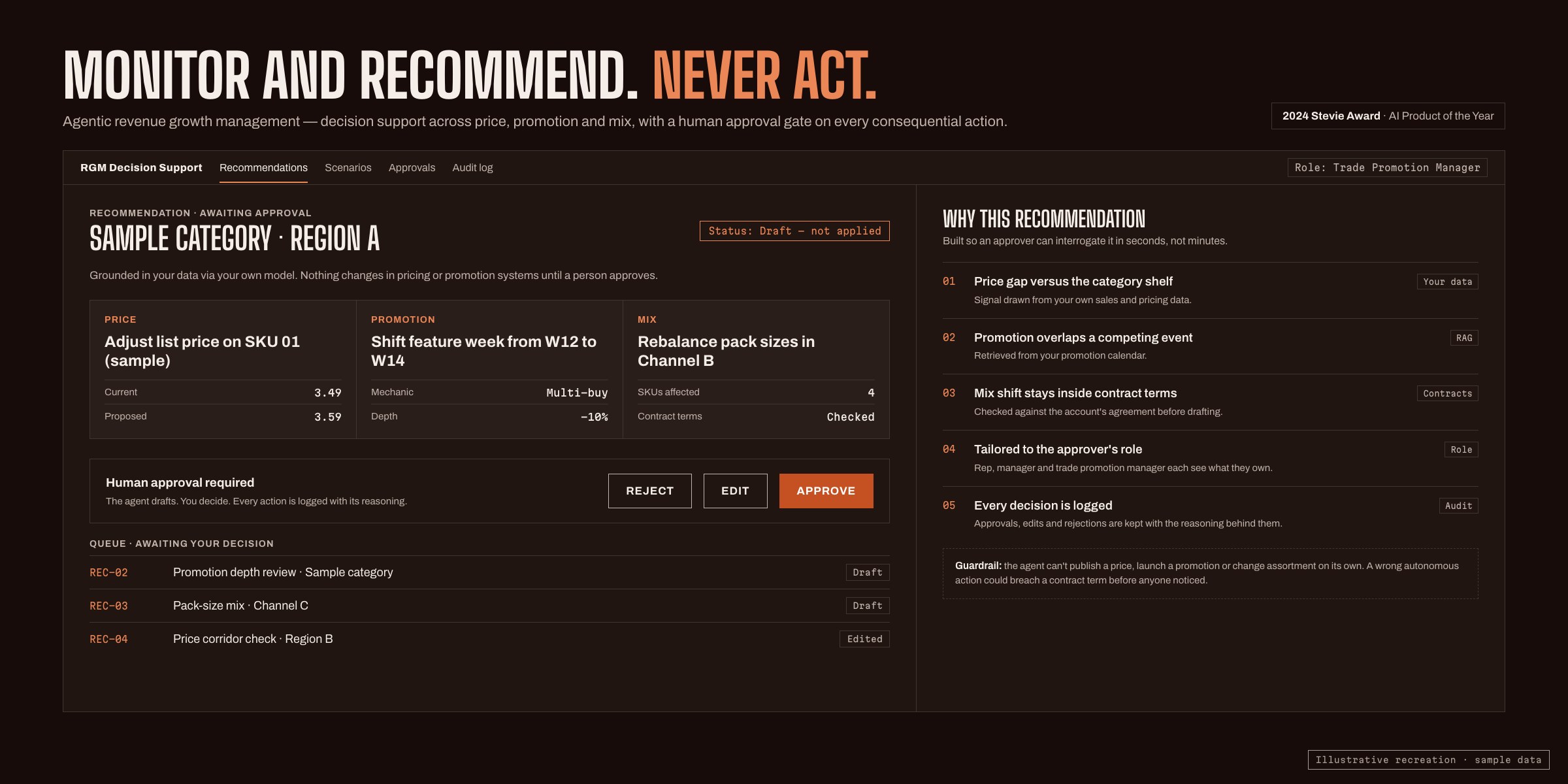
I led product and go-to-market for an agentic revenue growth management (RGM) platform: software that helps large CPG companies decide price, promotion and product mix. Interviews with Revenue Management Directors and Commercial Finance leads at 8 target accounts said the same thing: they asked for help deciding what to do next, which moved the roadmap from reporting to recommendations.

Buyers kept stalling on data residency, vendor lock-in and "we already bought a model". I built the product on each customer's own LLM and data, which removed all three objections at once. And because a wrong autonomous price or promotion can breach a contract before anyone notices, the agent recommends and a person approves every consequential change.

2024Stevie Award, AI Product of the YearFor the RGM platform.
1 + 2First enterprise deployment, then two follow-on dealsI also owned discovery, ROI calculators, battlecards and executive demos.

Try the promotion lab on the home page

Case study: the RGM platformDiscovery, the architecture choice that unblocked deals, the approval gate, and the four metrics we measured.Read it →
Independent · built solo

FieldIQ: AI agents for the rep in the aisle

After 7.5 years of shipping, I stepped back to ask what we had never built, and why. The answer became FieldIQ, an AI field-selling app for CPG reps that I built, from discovery and prompt design to test suites and integration.

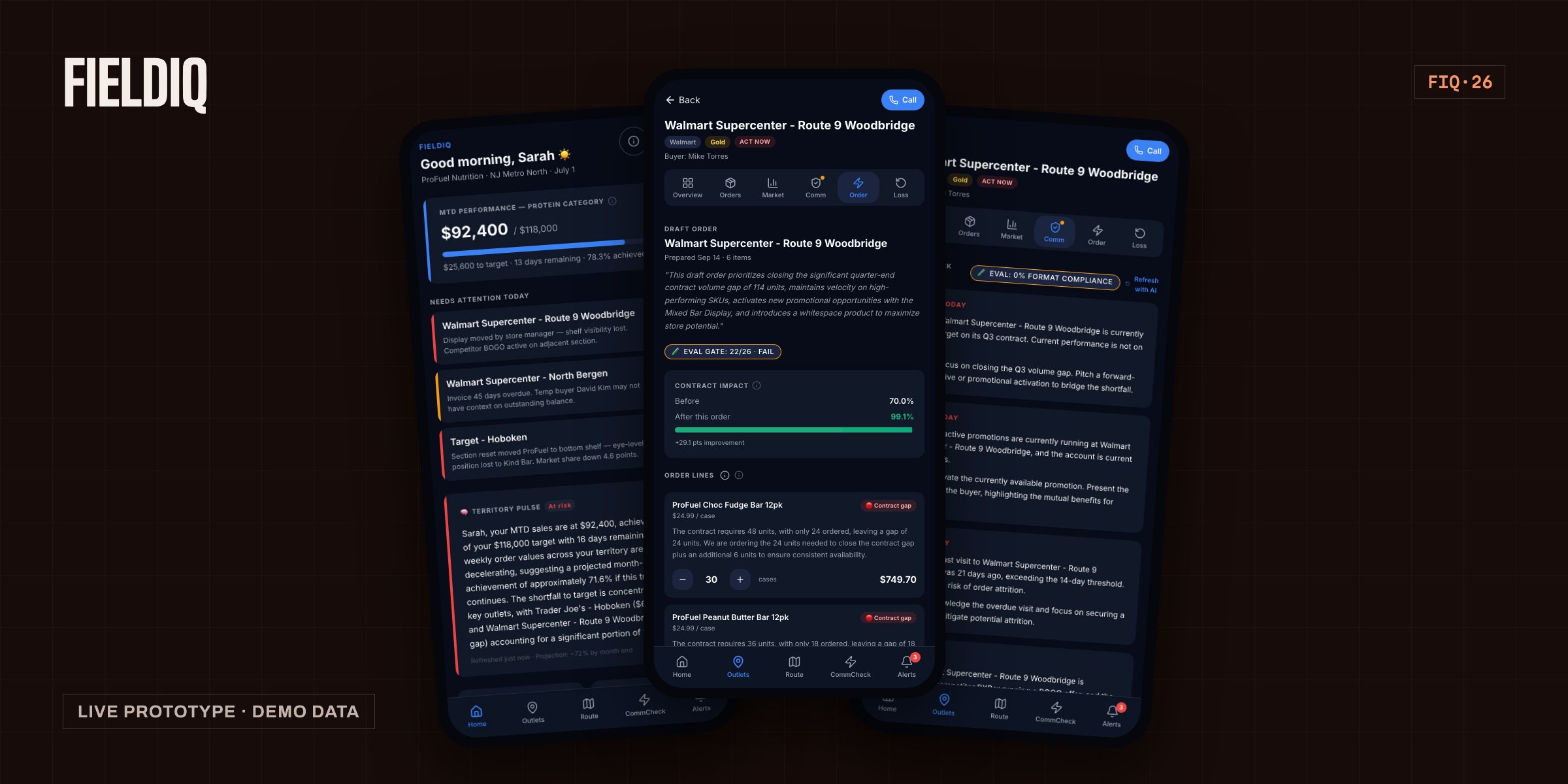
Four agents work in the live prototype. Draft Order Agent proposes an order line by line, each with a reason and the numbers behind it, and the rep edits before submitting. CommCheck sorts pre-visit signals into Act Today, Opportunity and Escalate. Territory Pulse writes a ten-second territory summary. OnboardIQ finds where a new outlet is stuck.

Every release has to pass a test suite. On the seeded run the order agent passed 22 of 26 cases with 3 critical misses, so the gate failed and blocked that release.

FieldIQ on three phones: home dashboard, Draft Order Agent and CommCheck, demo data
Live prototype, demo data.
4Agents liveTwo more specified: ContractRadar and PromoPostMortem.
22/26Ship gate: failZero critical failures and ≥90% pass required.
Adoption is a product design problem.

When reps avoid a tool, I look at the design first. Field users want fewer decisions to make.